Showing posts with label capoeira. Show all posts

Wednesday, November 11, 2015

The Real Rio de Janeiro

In Portuguese de novo (je nofoo) means again, which is the line you hear most often in any capoeira gym, or cheap beer commercials. Do it one more diime. Two weeks ago I found myself at the foot of famed Sugarloaf in Rio de Janeiro - de novo.

Last time it took me a year of riding cycle to arrive in Rio de Janeiro. Still, it seemed more final now. Like I was about to give up my Greencard. Yikes!!! Mariano, Bebum, my two closest buddies on the epic adventure, and I had always talked about how we would never stop.


#nunkapara

We wanted to keep riding forever. We'd combine our bro-losophical interpretation of The Power of Now with the teachings of the Capoeira roda and share the fantastic result with the world. The roda, any Capoeiristas’ Stonehenge, is our focal point and, to us, a perfect representation of life (Mestre Acordeon says so). In the roda only the truth remains. In the roda we engage in ritualistic combat. We laugh, we cry, and we face our fears and insecurities. In a circle of friends we must Be in the Now, the way Buddha and Eckhart Tolle tell us to strive for enlightenment.

But here I am, back in Rio. I wasn't riding to Argentina or Chile with my brothers. Gone were our dreams of life on the road, of sharing our bro-losophy with the world. Mariano is starting his PHD, Bebum is selling art in Colorado. And I? I followed a beautiful Levantine girl to Brazil. Might as well write about it, right?


Rio, the marvelous city, the shiniest pearl in Brazil’s necklace of glorious tropical beach life, is sort of readying itself to host the 2016 Olympics. I say sort of, because while the Germans seem equally corrupt when it comes to bringing the World Cup home, they are somewhat more efficient about it. So Rio is renovating turn of the century faux French and Austrian architecture here and there, tearing up roads for a tram line to nowhere, and adding overpasses like stairways to heaven - as such, also to nowhere - to the dedicated Airport bus lane.

Small pockets of the faux architecture have somehow survived between an invasion of supremely ugly technocratic 70s structures. A far cry from the fancy-full Jetsons Niemeyer architecture of Brasilia.


Concrete is apparently patient. Even under the onslaught of tropical mold and latin laissez-faire, which is more laissez than fair. All of which leaves zero room for public transport systems in the already too narrow Gotham like canyons of the overpopulated megalopolis's L-shape. The sea in front and the abruptly vertical peaks in back barely leave half a mile of sweaty, Blade Runner Marvelous. It creates a Victorian corset, the fish bone kind, requiring a torture contraption to tighten Rio into a waif. She is so skinny, she only needs one Subway line but fairly bursts from both ends like a Samba dancer’s ample bosom and bunda. Sadly, in the case of Rio the only thing bursting is marvelous amounts of refuse and mold.

I spend a week in Rio. A week that doesn't fit on that perfect Rio postcard everyone sends to their jealous friends. I stay in the Favela of Santo Christo, right next to the oldest Favela in the world – Providencia. It’s where my B2B peeps Amber and Juanjo live. It’s not where I would choose to live. I’d be up on a hill Favela, with the cheapest best view in the known universe.


A gondola runs from the Central Metro Station up to the top of Providencia. I wonder if the gondola was built by Austrians – ski lifts and gondolas are our second most muscular export. After Arnold Schwarzenegger.

On the day of my arrival I go to the local Favela clinic with Amber. Amber is seven month pregnant and has a meeting to set up a meeting about how the birth thing is going to go down. Brazil is on a drive to institute better pre/post natal care in its public hospitals. This requires intense communication strategies because low income people have a low information level about personal health care. Amber partakes in these because as an unofficial resident she goes to the Favela Clinics.

As in the West, Brazil's private hospitals push the Caesarian variant while public hospitals don’t. I am told this is because public healthcare has no profit motive. Brazil : USA = 1:0
Being a unofficial resident Amber still receives free health care. Brazil : USA = 2:0
We arrive at the clinic. It’s a nice, little low-slung building with a long corridor and two large openings at either end. People walk slowly. They talk to each other. I get a feeling that here care is actually a part of health care. Compare this to the frenzy in any public clinic in the USA. Brazil : USA = 3:0
It’s a good thing too. Brazil needs a solid win after my German bros beat their ass like a steel drum in the World Cup.

I spend days walking around Copacabana and Ipanema. As impressed as I am with Brazil’s efforts to better the lives of their poor I remain unimpressed by the marvelous city. I go to that lake under that dude holding his arms up on a hill like he’s got Walla-Pit (Going to have to buy my book to find out what sort of nastiness exactly that involves).


He blesses all the white sheep at his feet and turns his back on all the black ones living up in the hills behind in the City of God. No matter where you walk though, the streets are always dirty and so are the buildings. Even in white people land of Zona Sul. The really funny thing about writing this article is to learn that in supposedly none-racist Brazil the census form asks people of Asian descent to check the yellow box. Hear that Chinese/Japanese/Vietnamese/Indonesian/Thai/etc Americans? Ya'all are lucky!

Back to cracker land, which instead of mold and dirt also has no parks. It’s a total concrete jungle. Moldy high-risers obstruct your view of the impressive tropical cliffs and the perfect, rather exclusive beaches. The food is crap, everything is fried and overpriced. And it rains all the time. The only time the sun is out reliably is in fall. Exactly four months before the Olympics. I like the Favelas better and can't wait to go to Salvador. Somehow poorer problems are more honest problems.


To get around I take the subway with its advertisements to advertise because “Rio’s most interesting people take the subway.” Rio’s most interesting people are all white. The bus, which I also like to take, is 70 centavos cheaper. There is no air-condition on the bus.


The upper class people are still incredible rude getting on the subway. Apparently, fuck noblesse oblige when its about getting on that train. Even though the arrows painted on the ground in front of every door tell embarking passengers to wait on the side of the doors for people to exit they stand right in front of the door and literally sprint into the subway as soon as the door opens a slit. Leading to this:


I long for my days in Tokyo with those white-gloved Subway administrators apologizing (Sumimasen) as they gently push me and the crowds into the trains. The Rio subway rugby scrums, on the other hand, are the only opportunity in my life to pretend that I am the All Black, mostly because I am a head a taller than all these rude, little, upper class assholes. The contest does not end well for most of them, especially not when I am pulling two full suitcases.

Marvelously, once they are on the subway, they turn back to being the perfectly polite Latin Americans, giving each other space, taking each other’s purses and bags as they sit down so that the standing person doesn't have to carry it. Offering even me a chair to sit on - because of those two suitcases. This noblesse oblige lasts thirty seconds, or until the next stop. Then their exit/entry Mr. Hyde returns with a vengeance. I notice people's inability to wait their turn everywhere. It’s like the whole country has a massive case of FoMo, of not being with it, of not being fast and modern enough. Yet they walk slower than Hawaiians.

Though it is too rainy to go to the beach I still ask Cariocas (Rio natives) what beaches mean to them. I feel like it must be a center of their lives, lasting childhood memories are surely made there, tasty coconuts, memorable footeball games, perfect asses. They tell me that they never go. Which makes me wonder what the hell the point of the marvelous city is. Other than providing post card jealousy of course. If all you do is fight on the subways, walk through moldy concrete jungles, eat shitty fried food and live in fear of Favela muggings where exactly lies your happiness?

I found mine on the flight out. Rio has two airports. The “modern” one, which is two hours outside of town, and, you guessed it, undergoing its obligatory Olympic face-lift, and Santos Dumont. Santos is right smack in the middle of town, ten minutes’ walk from the Subway station Cinelandia. Saunter past the museum of modern art, buy yourself a bag of delicious tropical fruit for a very small amount of cheap Reais and walk right onto your flight. A flight that will remind you of Goldfinger and The Girl from Ipanema. Beautiful, luxurious and completely fake entertainment icons, that, just like the Sound of Music, make you think the place is the perfect masterwork of  the supreme being of your choice. Since they can’t all be the supreme being's masterwork it’s obviously bullshit.

From the air though, slowly rising through the mists of Botafogo and over the Sugarloaf, drinking cheap peach juice instead of a shaken Martini, I admire Copacabana’s and Ipanema’s endless yellow expanse, and the city, miraculously, becomes marvelous again.


Wednesday, October 22, 2014

stuff

So I decided to go on this crazy year long bicycle journey to Brazil with Mestre Acordeon 2 weeks before the thing started. Yes, I know it may have been better to plan this a little longer. Or not. If you are new to this blog you can check the ridicolous chain of events here and here. The first inkling of what I was getting myself into was an excel sheet that I received from Bebum - "why do today if you can do it tomorrow". It was a monster of an equipment list that the B2B crew had put together to ride to Brazil. I also needed to get a bike.

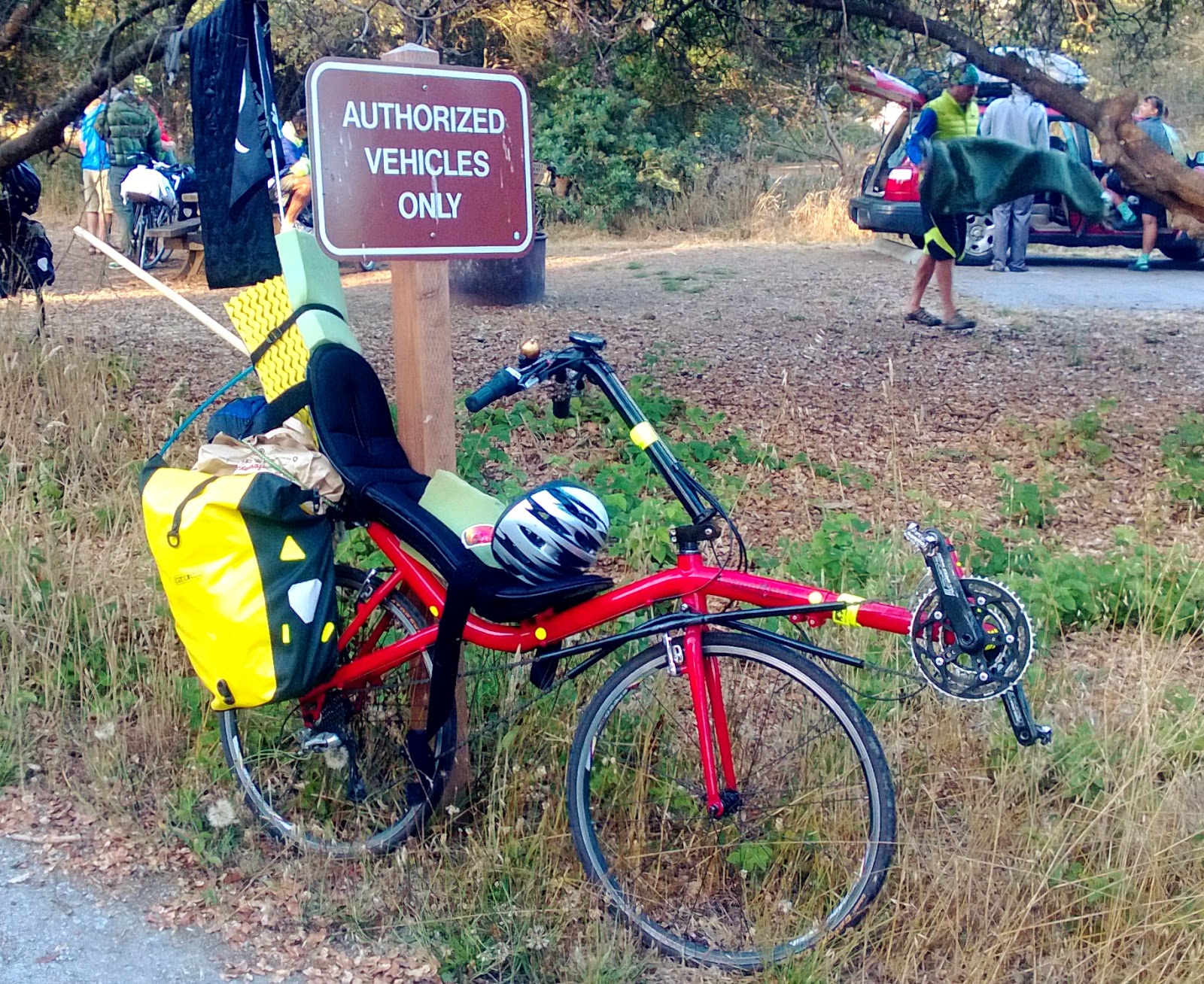
Clearly a bike that only a guy standing on his head would think is fit to ride to Brasil.

It was, in one word, intimidating. I stopped counting at 200, and started thinking of what I could do tomorrow. But it had to be done so I'd go to four different shops and buy… exactly none of the items. Insect repellent, biodegradable soap, water purification methods. Stove, pot, which fuel to use? 500 and one things for a medical emergency (!) kit, clothes, sleeping bag, tools, patch kit, replacement parts. Bear spray, dog whistles, bike bell, reflectors, pepto bismol. It had no end. Though at least it did not recommend diapers for Montezuma's revenge.

I don’t know how (thank you, helpful friends), but two weeks later as I lined up on the first day of my new lives with all the other crazy riders I managed to have everything packed in my panniers and strapped to my ridicolous Recumbent Bike. I was prepared! Nothing could harm me or my trusted steelhorse from here on out.

Sorry, not authorized to go to Brasil!

Of course on that same first day Bebum and I camp out on the beach in San Francisco and the rest, especially Bebum’s bike, and gear and half of my stuff were, as they say, history. I still wonder what the bum did with my greencard. I mean, if he is one thing, he is legal to be a bum in the USA.

So after being robbed of all our stuff Bebum had nothing but his tent, sleeping bag, Chapul's Cricket Bars and some cash left while I had been liberated of my wallet including some cash and all my cards, my clothes, sleeping bag and bike stuff. Fate is an ironic bitch. On the day we left Bebum probably had as much stuff as fellow B2B rider Tora. A day later, not so much. You can read how we stayed positive throughout that crazy second day here. We did not have access to any real resources until my replacement cards came, which was four weeks later in Los Angeles. We could not buy clothes, gear, or tons of food. The little money that Bebum had was spent on a bike for him and fixing it. So we made do. And making do we learned that we didn’t need most of the stuff that was on that monster list. For a month a used Trader Joe's re-usable plastic shopping bag was my second panier. It was a pain in the ass. It worked. I also went shopping with my big ol' five Dollars at Goodwill.

Didn't buy this ridicolous hat.

This one seemed much more stylish at the time.
M. Mago clearly approves.

Before I left my swankily located yet sparsely inventoried apartment to sit my butt on a bike for a year I did not own a lot of stuff either. I had been moving around the world since high school, twenty years by now. Naturally, if you are moving from Austria to Australia as I did, you don’t bring more than what Quantas allows. When I moved to LA a six years later I had two medium sized bags to my name. Another twelve years, five cities, endless road and world trips later I packed up all the belongings that I wanted to keep after the year I was planning to be riding bike. Everything else I gave away.

I remained with two bags of clothes, a bunch of books and a blender. I seem to have an essentially functional relationship with stuff. I need to wear stuff, I like to read stuff and I blend stuff since I recently found out that I can’t eat most things normal in a western diet.

How much stuff someone needs to be happy varies widely from person to person. Some of us need more stuff to be comfortable, some of us need less stuff. Since it was me, not a horse, not a dog, not a woman or a slave carrying my stuff, I was rather sensitive about how much stuff I had. And yet, over the course of a year of riding bike stuff accumulated, again. It's as if stuff, like mana, magically appeares out of thin air. Periodically, I would have to go through my stuff and, you guess right, give stuff away. If you are tired of reading the word "stuff" a lot, you can stuff it.

That fourth t-shirt that a really nice capoeirista gave you in San Salvador? Sorry, donate it, you only end up wearing one to three shirts. Remember him in your heart instead. The biodegradable soap? Donate it, its lighter to use normal soap. Stop washing your hair. The third pair of sports undies? Donate them to Sondermüll. The headlamp? Donate it, you have a bike lamp that miraculously gives light too. Toss the cutting board, are you kidding me? Toss the tent, get a hammock. Keep the knife, stove, pot and your girlfriend’s spices. Keep the sleeping bag. Keep two of every clothing item. Keep your bike tools, a sowing kit and electric device chargers/adapters. Go ride. Still getting to many flats because your bike is too heavy? Throw some stuff out.

The lighter I got the easier I felt.  Bike riding is not only a gloriously meditative and healthy see and smell the world activity. It’s also a direct feedback loop on why possessions are bullshit. Because, like you, I ask myself: Other than clothes, food and a place to sleep what do I really need on a bike? And to take this to a logical conclusion, is my normal life any different?

So, get rid of stuff. Move into a smaller house. Be Dutch. Channel your inner Japanese. Live small. Do what you love, instead of wasting time on work so that you can buy stuff you think will make you happy but that you never use because you have to work so much to pay for it. Work 30 hours instead of 50 and hang out with your kids more.

For those of you who already do this >> great stuff. For those of you, who want to tell me fuck it, I like stuff, that's cool too. Everyone is different. Tora had every item under they sun, just in case. He spent two hours every day organizing his stuff - and it made him happy. I on the other hand did not have so much, went for many swims, did unnecessary bouldering, played flute, wrote some crap that nobody wants to read and watched that grass grow or that small mexican city plaza flow - and it made me happy. Bebum had a didge. And two bikes more than all of us.

I am not the keeper of your spare time and Tora is not the judge of your effectiveness. I can not tell if that 20th pair of jeans really made you happy and Tora doesn't know if that snake venom remover kit should have been in my bags after all. We all are the makers of our own happiness.

That being said. Get rid of some stuff. One day you might have to carry it.

Monday, May 19, 2014

Panamerica

You live in the best country in the world, right? In your country you feel at home. There are special places there, places that you can't find anywhere else, that you feel emotionally attached to. Your food is completly tasty (ok, not if you're a Brit) and you would never visit a doctor in a foreign country unless you had to. Even if you suffer corrupt leaders or environmental degradation it is hard for you to imagine a better place to call home.

Have you asked why?

We are all subject to a constant stream of patriotic image creation. Your country's government directs this strategy early on in school (pledge of allegiance) and media outlets all over the world happily continue to feed the nationalistic beast. One or another entity constantly spoon feeds us how we are supposed to think about our selves, our neighbors, our homeland - sometimes the spoon is golden, sometimes its a ladel, sometimes a cudgel. Plenty of historical memes help us interpret our reality. It is easy to base our understanding of our place in the world, our selves and how we relate to people in other countries on these thought patterns.


We all think we come from the best place in the solar system, and the sun specifically shines her rays on our dog's ass.

In the USA people are convinced that they have the best life style in the world. The richest, most developed and monied place in the world. Yet, the USA just kicked off the worst economic crises since below. The healthcare system is a joke and a significant part of the population is excluded from this wealth-creating, resource-consuming machine.


In Austria we base our self image on a long, storied history. We are small now, but we used to be big. Vienna was the original melting pot of the world long before New York or London. Just look at a Viennese phonebook, you will hardly find any german names in there. We used to create art that the world appreciates to this day. We live in a grand, golden past and struggle with the present.


It is difficult for us humans to see this reality because we are group animals. We are used to rolling in a pack. All packs have rules and in exchange for following these we receive the benefits of being part of a group - protection, support and social interaction. I have only discovered one way to counteract this, leaving my leetle Austrian pack. As opposed to The Terminator, I probably won't be back.

I have been silly enough to move myself from one continent to another three times. From Austria to Australia, then to Japan and finally to the USA. Silly, because only people who don't know any better keep doing this. Each time you must build a new life, find a new pack. For some reason I have enjoyed this so far.

Now, because I am following a crazy old man, I get to ride through a string of countries on my bicycle. B2B, Mestre Acordeon's project to document the development of Capoeira in the Americas, affords us insights into countries, societies and cultures that I never dreamed of.

Panama is one of those countries. A nation at the mercy of international politics for centuries and one that, like all the other Central and South American countries, suffered Spanish Conquistadores and the consequences of being a colony. A small country can only fall in line with the powers that be. After having supported Panama's secession from Colombia the USA obviously made sure to keep its strong influence here in order to control the Panama Canal.

The country lies at the skinniest part of the two Americas, forming a thin connective tissue between two continents. This alone produces a meme of connectedness and international relations.  The Canal only adds to this creation myth. Now Panama is not just the hugely important north-south connection, in fact it is the entire world that flows through her gates. The only other place that has similar powers of inspiration would be the land bridge of the Bering Straight. But who would want to deal with the temperatures of an ice age? You'd probably have to hunt Mammoths and fight Saber Tooth Kittens too.


Panama built an image of itself as a connector between worlds, cultures and trade. Panamanians appreciate their melting pot way of life. I can't count the times that I saw a Panamarica/Interamerica store of all varieties or an America Import store while riding. Of course this country imports things from all the Americas, even if its just coming from Costa Rica or Nicaragua.

Whats that say on the bottom right?

Before the recent US-brokered freetade agreement Panama did not trade very much with Colombia. The two states have a complicated history. In a Politics 101 nutshell: once Panama realized that they can make a good living on their own with the about-to-be-built canal they split like hell from Colombia and started their own little fiesta, with the support and protection of the USA. This of course is quite the quit pro quo, hence being beholden to the powers that be. You can imagine that Colombia is none too pleased about losing control of this cash cow.

Awesome Panama Canal

Perhaps as a consequence of the complicated history no roads connect Panama and Colombia. The Darien Gap, a stinking reptile and drug dealer infested mud hole makes it impossible to pass on a bike, on foot or by car - still the preferred mode of transportation. Except if you are this guy (I can't recommend enough for you to watch this grainy video, its true explorer stuff). The country that thinks of itself as the connective tissue between two continents is physically cut off from one of them.

But that's no biggy, you can just run a bunch of ships. Tons of them. Just like you are used to doing anyway with that other gigantic global umbilical cord - The Canal. Oh, you dont do that? Really? No ferries, no freight ships, no joy rides? Nada? Nunca? Only random private boats that ship lost backpackers and crazy cyclists through the San Blas Islands from one country to the other. If you have a car, or OMG, you are trying to ship some Bananas from one side to the other you are, as they say, rather far up the shitty creek. Which happens to be island paradise. Not that we at B2B are complaining. Tranquilo.


Lost sail boats and the rather authentic Kuna populate the San Blas

So, if you have an impassable piece of real estate on your southern border and there are no scheduled ships going around it, how can you consider yourself the world's top continent connector? Containing multitudes. A land bridge containing and communicating multi-cultural influences and tastes. An istmus even. A hot international property in the process of tossing off theUSA's yoke for good.

This makes Panama a fairly straight forward example of why it is important to travel so that we may understand our patriotic assumptions for what they really are. Assumptions. Propaganda. Or as Pirata would say - Bullshit. It is easy to defend your opinions about the USA or about China. So many factors influence the images of these countries that, as with some religious texts, there is much room for interpretation. This is more difficult for Panama. You either connect, communicate and melt in a pot, or you don't.

So let us all happily profit and learn from Panama and try to examine our assumptions about our patriotism, about our countries' good and bad sides. Maybe we would discover a bit of humanity under all the vulgar propaganda. The stuff that connects rather than seperates us. Like a land bridge. An istmus even.


Saturday, April 26, 2014

the power of capoeira

What if Slavery did not exist? What if this human evil never was? No African slaves in the Middle East. No Arabic eunuchs in historic China. No slaves in the Americas. No sex slaves in today’s Asia or central Europe. No slave-like work conditions in under developed countries around the world. No slavery. Period.

A beautiful thought. An alternative universe. Someone should write a novel about it. Yet it is risky to handle a topic that carries such heavy emotional weight. One very big geopolitical question immediately arises. Would the West have developed its current dominance without milking the colonies using slave labor? This question is of course interesting, in particular considering the countries B2B currently travels through, but for now I would like to concentrate on the “somewhat” less controversial connection to Capoeira.


Only one very simple, yet powerful question remains in this context. Would there be Capoeira? Would Capoeira, this art form that allows people everywhere to express themselves freely, that forms such strong communities wherever it goes, undergo this powerful diaspora out of Brazil?

You may believe that Afro Brazilian slaves fought their overseers using Capoeira, or that Capoeira developed much later in the harbor towns of Bahia. This complicated history is shrouded in undocumented mysteries. We mostly just don’t know. In the end what matters is that Capoeira’s roots reach back to Mae Afrika. The people who practiced Capoeira in Brazil, the way Capoeiristas move and the rhythms all point to that far away mother land.

When you ask a Capoeirista why they dedicate so much of their time to it - what makes Capoeira their home - it will not be long before they mention community and love. The group that supports them. The sisters they look up to as role models. The parents they had lost. The family. The Roda. Because of this community forming power and because many Capoeiristas discover new approaches to life through their practice we speak of Capoeira’s extraordinary ability to transform lives.

In Capoeira we travel to our brother and sister groups to attend their events, and they come to ours in return. During these events we treat each other like one big family. We don’t put them up in hotels and let them fend for themselves, the way it is if you attend a sports tournament. We ask them to sleep at our places, we cook for them, we pick them up from the airport and drive them around all day long. We show them the town, take them to cool night spots and try to meet all their needs. And we beat the stuffing out of each other in Capoeira workshops, eight hours a day. Do this for a few years, and suddenly your Capoeira family extends across the continent. Many of us can go to five different cities in the country and have people to hug and a place to stay. B2B in particular is blessed this way. There are no words that can describe the hospitality we receive on our journey. “Mi casa es su casa” simply does not do justice.

Yet the biggest transformation that Capoeira affects is not on a personal level. It is to transform a great human evil into a great human force for love, for positive change. Capoeira comes from slavery yet today spreads joy, art and community.

Born out of hatred, forged into love.

Even though Capoeira to this day is often carried to new shores via the dark and dangerous ghettos of Brazil, it arrives carrying a message of community and love. Maybe it is the pressure from the new environments that forces our Mestres to let the more martial aspects of Capoeira go. But we can not deny the all-enveloping family that these leaders attempt to create.

Inside of Capoeira we know this. It is our daily bread and salt. If you dedicate your life to our art you will end up spreading the good word to whoever will listen. You will start your own Capoeira school somewhere and hope there is fertile ground for it. If you are from Brazil you will pack your bags, move to Austria or Russia and bemoan your freezing bones. You will follow your dream to the USA, or to Australia and Asia, and you will wonder at the cold, distant nature of the strangers around you. Yet, you will start with a little seed of a germ of a plant of a tree of a Capoeira Akademia. You will BBQ and make Caipirinhas with your students, you will help each other move. You will be best men and brides maids at each other’s weddings and help raise each other’s children. Small communities will form around your Akademia. Every day you will sweat, kick each other and learn together. You will feel the power of focused synergistic human energy in the roda. Your group will become your tribe.

Born in shackles, forged into freedom.

Capoeira has room for all. There are as many styles of jingas as there are Capoeiristas. Although your Mestre will try his best, and for years, to teach you his correct version, in the end he will tell you that your Capoeira is your Capoeira. And that the way you express it is your freedom. It is a simple yet difficult to understand concept. The easiest way would be to watch a Roda and pay attention to the intention of the players. Their personalities emerge quickly. Don’t be distracted by the flashy moves and the backflips. Some smile constantly, as if something is tickling them. Others seem to be very playful but it is only a mask. Others yet again play very direct and to the point. For women, the great advantage of Capoeira is that they do not need to rely on pure strength for the effectiveness of their game. Speed, flexibility and use of space are just as valid a weapon. Some will never hit you, while others can’t wait for the chance. Know a person’s Capoeira and you will know them. And in that variety we all find our own personal expression, our freedom. Our opportunity to be ourselves in a much too straight-jacketed world.

Whatever race is yours, whatever creed you follow, whatever levels of individuality you adhere to, if you enter a Roda boa you will be a part of it for the rest of your life. It addresses a basic human need to be part of a kin in a deeply ritualistic and yet realistic manner. The process of making music, of focusing our combined energy, the sweat and blood we spend each day, bind us together. Why? That is probably better answered by ancient knowledge or simply through being human. The good thing is that you do not need to believe it to experience it. All you need to do is play.

And follow one of the Mestres eking out a living trying to get people to sing a damn song in Portuguese. So that there may grow a small seed of love in a barren concrete ghetto, in a soul-less school of drones, in a world that too easily forgets our tribal human roots.

Mestre Xuxo, in what must be an Austrian ball room

Maybe you are lucky and are in one of the 5 different Akademias across 4 different states in Austria that Mestre Xuxo teaches in and drives hundreds of kilometers to every week. Maybe you are an alumni of Mestre Pelourinho who managed to convince the United States of America immigration Agency, a notoriously flexible bunch, to give this amazingly bendy and impressive, big haired Brasilero a visa that enables him to teach both in Tijuana and San Diego on the same day.

Mestre Pelourinho in San Diego and Tijuana

Maybe you are part of one the tens, if not hundreds, of small capoeira groups across Central America who yearn for a Mestre but only have Mestre Youtube or themselves to learn from. Or you are Professor Arame, a stringy beanstalk-like Mexican Capoeirista, and you move to Lebanon and teach Capoeira to refugee children and battered, abused girls in NGOs across the Middle East.


Bidna Capoeira and Prof. Arame changing lives in the Middle East.

What these Capoeiristas all have in common is an astonishing appreciation for their students. They make their daily struggles worthwhile. As one they tell you “I do this for my students. I love to see them grow, change their approach to life and finally become Capoeiristas. I don’t need money, I don’t need fame. What I need is my family. And my freedom.”


Sunday, April 20, 2014

antropologia – experiences of a bicycling tribe

We ride our bikes a lot. Riding your bike a lot affords you a lot of hours, days even months with only the space between your ears to entertain you. It surprises us how much thinking we can do when we are not distracted by work emails, mom’s emails, Facebook status updates, twitter posts and old school music & TV. In a group of ten someone always seems to be hanging around, yet we spread out over miles during the day. You can ride with someone, but if you want to be alone it is only the push of a pedal away.


Right now many of us face internal tests of one kind or another. I recently felt I was missing my life in Seattle, my friends, my capoeira, my home. I have been living away from Austria for nearly 20 years but I never felt homesick. When I told my mom that I miss her the other day she said “Vell, but you get to see all zese zings zat other people never veell have a chance to see”. Mom’s the wonderful word.

We all miss our Capoeira routines because we don’t have the energy to ride and train. We did some rough riding recently – over tall mountains, back into the pacific side heat, long days with heavy head winds. And we have been on the road for nearly eight months. We feel physically exhausted. We miss home. The desire to keep riding is not as strong as it used to be. After going through eight countries, the newness of crossing borders is not as exciting as it used to be. This side of Centro Americo is dry. The other side is wet.

The work we do can be challenging. What to shoot? When to shoot? Is the light good right now? Often the sound is the deciding quality factor of a recording. Funneling the tons of material through various processes to be categorized and analyzed - hopefully, turning into stories at the end takes up much of our time.

Group dynamics also create difficult situations. We are a strange traveling bunch. You can not call it a democrazy, because in the end there is only one person that makes decisions about the direction of this journey. So it doesn’t happen that we fight over which ruins or city to visit or how long to stay at a beach instead of pushing on. These decisions are usually not up for discussion. It takes out a lot of potential conflict.

As a result, and because we all have a shared Capoeira background we understand each other well, except for some cultural differences that we usually resolve in the roda. However, no matter how well we understand each other - “No, it is my turn to get the bed”, how much we disregard our own opinions to follow our fearless leader - “Why did you not tell me that you would turn here”, at times we make each other mad “What, you are still here?!?”

Sometimes we need to get a way. This, most of you would agree, is completely normal. Spend 24/7 with a person for 8 months, throw in a mélange of personalities and cultures… If you don’t try to beat each other over the head every once in a while you are probably weirder than we are.

Today this made me think of cavewo/men. The closeness amongst us and the absolute amount of time that we spend together make at least me feel like I should be picking the lice out of someone’s fur. This is quite the modern day approximation to a hunter gatherer life style. How would science look at us? Would they make us fill out punch card type pages of questions, put us into focus groups, check our pulse during stressful interactions? If you follow the news loosely, it seems that in this beautiful brave new scientific world new sub categories like Genetic Anthropology, explaining our past, present and future sprout like mushrooms - the good kind. I am of course completely jealous of this as back in my day you could mostly stare at monkeys or dig around dusty bowls for bones ‘n shards if you were interested in unearthing some of our deep human past. The diversity of research fields available today is astounding. We are trying to understand your brain, the exact location of your soul and everything in between.

The articles you can read in popular science magazines make you think that Anthropologists have access to Stone Age GQ or Time Magazine, they tell us today what the trends were back then. I once saw a representation of an ancient vase. Beautiful, long-necked, had complicated patterns. Like a woman you love. Next to it was the one (!) shard that had let someone understand the entire design. But in reality, we have some rocks here, a shard of a spear tip there, and a couple of wall paintings spread around a few European caves. Shards, like the tops of icebergs.

From these measly evidential matters we presume to discover why humans have language. Why we like to laugh. Why we invent things. Why we cooperate, when evolution demands competition. And further mostest why we didn’t just stay up in the damn tree happily munching on mangoes instead of crawling down into cubes and boxes. Now we need to learn that happiness is living in the now and that it us who have to be ok with any situation. When your zen is centered the shittiest situation is paradise manifest. Michel Foucault would have a field day with this internalized discipline thing.

Anyway, back to the cavewo/men. Even presuming that anthropologists have added genetics, nucleus level microscopic examination and unfrozen Mammoths and Ötzis to their arsenal we still need to ask how much of this science comes from infusing the past with the present? Outside of geiko commercials when is the last time you observed a hunter gatherer tribe? What happened in that cave, when one tribe member just could not stand that dude smelling like rotten eggs anymore? Did he learn how to cooperate? Did he take the other guy’s cavegirl? Did he just punch him out? What happened?

So, dear Antropologia, when you write that article about the necessity of cooperation do you experience cooperation in the close quarters of a tribe? While you write of the past, that you have seen in the deep bones of the earth do you know the joys of no escape from your family - ever. We are not just speaking of your wife and kids, but also of drunken Uncle Jimmy who always loses your car keys and Aunty Betsy with her three baby daddies. While you speak to us of us, while you tell us why we need to desire the things that we need do you have the pleasure of experiencing body odor problems or is it a focused group that you observe? Have you lived this? This ancient that you speak of. Your truth that makes us so.

Did you see the shard of a spear tip?

Saturday, February 8, 2014

mexico


This country would easily win first prize in a competition of the most misunderstood countries in the world. If you opened any US newspaper on any random day in the last 10 years most likely you found a glaring headline about the 10 million illegal immigrants, one or another tropical dis-ease trying to piggyback across the border, and the 80,000 people killed during the real drug war taking place south of the border. Coming from the north into Mexico it’s difficult not to think of the country as a heavily industrialized/militarized front yard to the Promised Land with everyone, including the trucks themselves, trying in vain to cross the border by the millions to reach all that sunny California goodness. Drugs, narco killings, disease ridden illiterate emigrants - a place with those kinds of exports has got to be the front yard to hell, not to the Promised Land. Which explains the horrified faces people made when I told them that I will ride bike through Mexico for a few months. “But it’s so dangerous”! “ Did you get your shots”? “Did you pack your iodine”? “How about that GPS Tracker”?

My personal truth about Mexico: It’s pinche awesome! It has a growing middle class, everybody wants to get more educated and the commerce happening everywhere is astounding. Yes, the income gap is still huge, but the USA better watch out. When the corruption problem is under control, it’s probably on. The Distrito Federal (Mexico City) is a superchingon (super cool) global metropolis and Mazunte in Oaxaca a black hole – plan more days for the Oaxaca coast than you think. And drink more Mescal! We have heard much about the hospitality of Mexico and you will be hard pressed to find a friendlier people. The further south from the border you go, the nicer everything becomes. Even though I would like to, I don’t think I can easily blame that on the USA. It doesn’t just get greener the more south you go, it’s also more developed, cleaner and often with a rich community and civil life thriving around beautiful town centers.

For over 3000 years the central high plateau that contains Mexico City has been the center of empires. One of the first high cultures in the world developed here, and since I am just a little blogger and can sometimes give less of a shit about source validation than the Catholic Church I am just going to say that only the pyramids in Egypt equal Tenochtitlan. Angkor Watt is of course magnificent, but the Khmer were not as focused on scientific advances. An incredibly wealthy and resource-rich society supported the mega projects on which the next three millennia of Mexico were to be built. Including today’s Mexico whose cities are built right on top of the old indigena towns. When the Spaniards were still Moslems (and learning math) the Aztec’s were making perfect celestial calendars predicting planet and star movements thousands of years in advance and into the past. We just don’t understand any of the gorgeous frescos they left us because we haven’t found a convenient dictionary á la Rosetta Stone (the actual rock, not the software).

On some level, gringos understand that there was cultural development here before Cortez and cohorts set hoof and metal clad foot on land in the Caribbean. But most of us probably think that similar to North America the Spaniards were met by hybrid hunter gatherers living a semi-nomadic life with little wealth to be stolen. Instead what he found were several highly developed city states. The fabled Fountain of Youth seemed just around the corner. Since about 400 A.D. these Aztec city states flowered on the ruins of Olmec Tenochtitlan. It would be like the Romans disappearing and the Greeks taking over the place, and then the Spaniards, and so on. Always copying and learning from the culture before.

Apart from thinking that Cortez was a god (proving again that religion is just never good for ya) the Aztecs lacked some crucial inventions and many disease vectors. Lethal disadvantages in global colonial politics. Very quickly the Old World concentrated on parts south of the Rio Grande to achieve worldly and heavenly glory. Spain and Portugal continued the largest genocide in human history in Latin America with a vengeance. Logically, they must have thought that there is more plunder in the grand cities of Central America compared to the roving bands of the North. The thievery of humans, gold and other unique materials (rubber, sugar) was awkwardly justified with a completely fucking ludicrous idea that the savages were actually profiting from all this. Mostly by gaining entrance to heaven, posthumously, you understand. The biggest and best brains in the just about enlightened world left us with marvels such as this one from Voltaire “Latin America is inhabited by lazy and stupid Indians who live side by side with pigs with navels on their backs and bald and cowardly lions.” Want more? Bacon, Hume and Montesquieu declined to recognize the “degraded men” of the new world as human beings. Father Gregorio Garcia managed to proof Semitic blood in the native population in the 17th century. Even for the Jewish diaspora this is quite an accomplishment. Maybe the Holocaust should not have come as a surprise.
               
So one day the heathen-killing, dis-ease ridden, illiterate white man arrives on the shores of this paradise. Takes your women (in your own house), makes your children his slaves for his death trap mines, sends your sugar to Europe and shows you that your gods suck by killing you if you don’t agree. Unfortunately, that was par for course when superior and inferior powers met during colonial times. 500 years later we witness the results. A nation slowly climbing out of the depths of poverty, crossing themselves every time they walk past a church. Symbols of absolute might built with the riches from the bellies of the Guanajuatos and Zacatecas of the new world. Gilden Cathedrals erected on the backs of enslaved indigenas. The argument that the industrial revolutions of the world, enabling today’s high western standard of living, were financed with the wealth stolen from the Open Veins of Latin America does not seem completely silly.

When a gringo tourist walks through a pleasant Mexican Zocalo today the church on one side of the square is the only edifice remaining from colonial times that is available for public use. If I were a local I’d throw eggs when I see what is left of my country’s heritage and wealth instead of crossing myself. Since the new Latin American (!) pope seems so focused on asking his colleagues in world leadership to create a more egalitarian global economic order maybe he could go to the next meeting in Davos and invest some of the billions that the church stole from Mexico in the last 500 years in education for Mexico’s poorest. So that those 10 million illiterate emigrants have a chance to succeed in their own country instead of having to cross a deadly desert into the pope’s apparently cold capitalist world.

Now let me ask you a question. If a country has had continuous civilizational development for thousands of years, creating marvels of science along the way, what does that make it? That’s right, China. The country that brought you noodles, paper and porcelain. Illustrious company for Mexico, you would think? As countries go, just a tad cooler than the sweetheart up north who gave you The Little Big Boy. And yet, we still stick to our arrogance, like our colonial forefathers, thinking that Central America is a dangerous yet pitiable place. This sentiment is couched in concern now, rather than racial superiority.

After 500 years of slavery, pillage and, finally, Herr Kissinger’s “Real Politik” a strong indigena element remains. In many of the small towns we rode through on our bicycles people present a different appearance than in the next one. Different skin shades, different facial bone structure, taller, shorter, fatter, skinnier, different clothes and different dialects. This genetic and cultural strength after centuries is extraordinary in a western world of mongrelizing mix and match. I for one am happy to be greeted by Mayan and Aztec faces, even though it twists my tongue into knots to call them by name.

Although this painful history has lasting impacts deep into Mexico’s present understanding of itself it seems that the country is moving in a good direction. I am sure to some this sounds like a naïve statement. I’ll defend it by saying I spent four months riding my bicycle through Mexico, meeting locals everywhere we went. Sleeping at the Red Cross, the Fire and Police Stations, Municipal Halls, Municipal Gyms, Restaurants, Hotels, Mescal Makers on roofs of Paleterias (ice cream shop) between the two borders. Countless Capoeiristas in towns all over shared their stories, ideas and thoughts.

Development, democrazy and civil society take time. Many countries in the world did not take these steps easily, gently or quickly. Being neighbor to the world’s single super power is one of the most difficult positions to be in because interests will often conflict. And what then? Pinche Gringos.

So Mexico, please be patient with yourself. Rome was not built in a day. Especially considering your oft brutal history. Austria fought a slow fusion civil war for twenty years between the two World Wars. Cut yourself some slack. The USA’s bloodiest war was its own civil war. Life seems to be, like riding your bicycle, a marathon.

And stop warning my about the dangers to the south of you, for example Guatemala. It makes you sound like a Gringo.

Monday, January 20, 2014

capoeira – an offer you can’t refuse?

Banano in Chacauha
If Capoeira is an expression of anti-stateism, of anti-authority, of anti-rule, of anti-slavery, how does this mesh with the near monotheistic adoration of individual figures within our cult? This article looks at the role of Mestres in the world of Capoeira how they exert influence over their groups and how some short-comings are often overlooked by us. Yes, this is all about sex, drugs and Rock’nroll. And some Capoeira.

Capoeira Mestres inhabit a unique space. They are the living embodiment of an art form rooted in some mystery. An art form that defies classification constantly evolves and has little international organization. Mestres bear responsibility for Capoeira’s practice and development. Through continuous involvement they must ensure that Capoeira’s inherent freedom does not lead to a dilution of the art and vice versa, that a necessary conservation of traditions does not result in a curtailing of a central basic idea of individual expression. Capoeira takes a lot from the individuals who mean to walk its path. On a life-long journey of this kind the opportunities to err by far outnumber all those perfectly white grains of sand on Copacabana Beach.

Yet when we are witnesses to our leaders’ errors we still put them up on our pedestal. And keep them there, though we hold ourselves and others to higher standards. What is this zeal born out of? This sect-like behavior. This inadequate examination of our voluntarily accepted commanders in chief. Is it because they can easily beat our ass anytime they want? A return to rather basic behavior patterns. Or do we mislike judging our judgement? Once we made a call we don’t want to admit that we were wrong. Maybe it is because deep inside we know s/he owns the roda that we play in and therefor also our Capoeira. Or do we just happily soak in this inexpensive letting go? We live in a world in which we are always supposed to be in control; of our selves, our family, our career, our emotions, our country. Or else that tree will be watered with a patriot’s blood. In this world it may just be plain nice to give in to an age old comfort of not being responsible. More positively and maybe realistically put, of being part of something larger than yourself. But if humanity’s behavior patterns are based on clearly established lines of command, what does it mean that those have mostly disappeared outside of the dictatorship we call work? Maybe following certain leaders in a religion, in a cult or in a martial art is a natural expression of needing a place in a pecking order.

Be that as it may, it is fascinating to watch Capoeira Mestres do their thing. If you are lucky enough to interact with many of them it stands out even more. It is extremely interesting for me (Don’t want to know how many Martellos that will earn me) to watch Mestres exert their influence over a group of people who don’t usually follow anyone’s orders unless it is within the context of that dictatorship thingy.

Most of us are usually too involved in our own closed system (read: daily grind) to examine ourselves and the people closest to us. We don’t see the forest for all the trees. And we are also too busy just keeping our lives straight. But maybe it is easier to try to examine your Mestre, since they take up so much space anyway. Think of your Mestre as just another person that you may see walking down the street. S/he doesn’t do backflips or randomly rasteras people, right? No lethal speed and strange interlingual philosophical depictions that somehow often seem to make complete sense, you just don’t know how. Would you think the person walking down the street is steeped in an ancient, heavily ritualized art? Would you think that they can open a place for you, inside of you, that you can not reach without help? In an unfinal analysis we are all complex human being, and it may be difficult to grasp a remotely complete picture of a person unless you spend years with them.

But sometimes we are allowed glimpses into other people’s worlds. Often those pass us by unnoticed. We are too full of living our own lives. And these other worlds can be too similar to our own to warrant closer attention. TV on the other hand, the story teller of our age, takes up a lot of our time. TV provides insights into other people’s realities. It fulfills a basic creative human interest for new food for thought. For seeing some greener grass on the other side. This is legitimate, right? We are surrounded by those who are much like us. And we are also pattern recognition machines. Made to recognize, file, store and ignore repeat inputs. So we constantly want new horizons and we tend to ignore repetitive inputs. All those ignored inputs make room and time for extraordinary events. It saves bandwidth for dangerous or cool shit. Basically, we are set up to be bored by life. Unless you go find cool shit.­

We can trick ourselves. We can put ourselves into situations that provide higher doses of outside input. Maybe our thirst for traveling is a result of this. On the road, we seem to become more in tune with the world around us. Less auto-piloted. Often this is jarring, yet rewarding. More so, if born with a smile worn. Also some professions are afforded a somewhat gratis fly-on-the-wall status into other people’s lives. Somewhat, because each must pay their particular price for the privilege of being a voyeur. Be you a paparazzi, a shrink or a priest.

I get to roll with a first class legend in a should-be Olympic sport that’s got a Public Relations problem worse than that thing on ice with a slow moving rock and some strange fellows rubbing the ground with brooms in front of it. B2B, Mestre Acordeon’s project to document the history of Capoeira’s development in the Americas and Capoeira’s influence on people’s lives is an amazing thing to be a part of. On so many different levels; the work of the documentary, capoeira, friendship, culture, personal journeys, meditation by bicycle. People tell us it’s the most amazing (loco) thing they have ever seen. And still they think we are a troupe of dancers.


To help with a better understanding of a Mestre’s world I could write up a quick long list of what happens in a Mestre Acordeon day, but like on TV you can see all that in the B2B videos, our pictures on Facebook and in our blogs. Instead it would be much more interesting to hear what you think a day as Mestre Acordeon on B2B is like. Here is a chance to walk a mile in someone else’s shoes. And if you want to get really crazy you can do this little mind experiment with the opening sentence of this article in mind. So write us some lines, make a video, or paint a drawing (however you or your kids like to express yourselves). You can do it here, drop it on Facebook or tell it to your pet hamster. It all counts. In any language.

Wednesday, January 1, 2014

mexico & capoeira

We have heard from tons of people about Mexican Capoeira. We have watched a bunch of Mexican Capoeira. We’ve played a couple of games here and there since we have been riding through Mexico for nearly three month. We have listened to Mexicans talk about Mexico, and about Capoeira. And about Mexican Capoeira. We are a Capoeira train with a super charged twin turbo diesel engine. What I am trying to say is that there is a lot of Capoeira going on for B2B in Mexico City. For those of you new to this adventure, B2B stands for Berkeley to Bahia. By Bicycle. It is a project of Mestre Acordeon - a crazy 70 year young (apparently) Capoeira Legend who has set out to discover the roots of Capoeira in the Americas. 14.000 Miles on a bicycle. This journey will result in a documentary, a music CD and a book. We get to roll with Mestre, through the Californias, Mexico and all of Central America. Have I told you that I love riding bike?

One thing stands out. If you want to think about Mexican Capoeira you can’t just separate the two entities. You have to consider both Capoeira and Mexico. You can take a taco guy out of his taco truck, but you can’t take the taco truck out of the taco guy. Even if he becomes a salad guy, he will toss your salad as fast and full of flair as if he was still making tacos.

So what is Capoeira in Mexico City all about? There is certainly a lot more than we thought. Maybe a few Professors, CMs and Mestres making a hard living teaching Capoeira in the USA are already thinking the same. Pack your bags. Forget your Greencard. The USA is not the promised land. Move south of the border. Yeah, I said it. There are 40-50 odd groups here. Where is that density in the US? Yes, Mexico City is a town of (a few uncounted) millions, but people with five or less years of Capoeira start groups here. And manage to make a living of it. We have seen the same in smaller towns all over the north of the country. Messy, mixed, mongrelized, Mexican. Happy. Maybe it is because many people in lots of countries do not have the luxury to choose between right and wrong, they choose between work and no work, food and no food.

Yes, some of these groups may seem commercial, zumba-ized even. They may not know the music. Or that the tocas in your roda are the tocas of your life. Tocas that can’t not be followed. But, as Capoeira grows, in the nooks and crannies of this dense and denser humanity, should we prefer some Capoeira, or should we accept all? Are we the judge of which Capoeira is worthwhile? Considering that none of us know an absolute truth of origin, do we have the ability, the right, to know the destination?

And how can Mexican Capoeira find its base? When Mexico itself has been working, justly, for centuries to know its own, to find its own and to accept it. If Capoeira is an expression of anti-colonialism, of anti-authority, of anti-rule, of anti-slavery, then how can it mesh with Mexico’s history? Or should it be a perfect marriage?

Two indigenous cultures on the tip of the spear of western, barely post-medieval society. A ruthless, greedy and blind society. A society that was surfing the accidental waves of geographical fortune and technological advantage. Raping and pillaging along the way, it left continents of confusion in its wake. Suddenly all power came from the barrel of a gun and the center of a cross. Each country eventually revolted against foreign rule, as did the Estados Unidos . Each revolution in its own way, leaving a legacy of historical influence, of deeply ingrained cultural memes. Do you wear feathers for equinox or are you from a quilombo? Are you a minute man or one of the child heroes of Mexico? Where is your past located and how does it impact your present?

Whenever you live these two narratives leave a lasting impact. It's beyond my experience and understanding to interpret this impact. As usual I only have questions for you. Does modern Mexico's self-image allow room for Capoeira, which is part of another nation’s creation myth? And do these two cultural constructs (big words, yes) complement/conflict? Someone could probably write a book about this.

One of the statements we heard about Mexican Capoeira is that players don’t speak to each other in a jogo. To speak one’s mind one must first know it, know one's foundation. And so, it may be that this stasis of expression remains caught either in a game of mutes or a fight. Mais nau um bom jogo.

Friday, November 22, 2013

California Capoeira

Capoeira is not big in the USA. It has been steadily growing for 30 years. But anyone who is trying to run a Capoeira Akademia will tell you that it is difficult to survive in this business. We don't have the national and international organizations that help other martial arts and sports with promotion and visibility. Crossfit is a good example. Individual gyms profit enormously from the marketing and advertising output of national organizations. Everybody in the States knows what Crossfit is.

Ask someone what Capoeira is. Most people don't know and the ones that try, make us cringe with attempts to classify a martial art as a dance. But it's not them, its us. What it comes down to is that we have many Capoeira small schools fighting to survive in an ocean filled with international Karate, Crossfit and Zumba sharks, who are all out to claim the few fitness dollars a person is willing to spend.

But California is different. Here we have UCA and Batuque. Two of the first Capoeira groups in the USA. Founded by Mestre Acordeon and Mestre Amen. Open Rodas everywhere. 'nuff said. Of course there is also Capoeira Brasil, of Mestre Boneco. But although the group is huge and international it is not of California.

So when we travel down the California coast line, while its not Bahia, we still find a lot of Capoeira. And because we have this crazy group of really good Capoeiristas we play a lot of Capoeira. On the side of the road, in parking lots, on the beach, in akademias, in parks and at Batizados. Its totally amazing and I feel incredibly lucky to be here. And its also extremely frustrating. How can that be? Its Capoeira heaven.

Because I can't play. My hip flexor has been acting like a rusted jackknife, although the biking is fixing it. I injure my wrist and the biking is making it worse. But more importantly, I am a confused Capoeirista. Why? I train with Professor Fenix and Candeias in Seattle. We practice a different capoeira than UCA does. Our Jinga is different. Also with only three years in Capoeira I am, and will be for a long time to come, a big capoeira baby. At some point, rolling down the coast on my ridiculous recumbent, I realize that this is a 24/7 batizado environment. I'm a nerd, I over-function. Bebum tells me to STFU and just play.

You know how when you go to another group's batizado you feel like a beginner? In a workshop you learn a kick and rastera combo but it just doesn't compute for you? This happens to everyone and it is why its so important to travel in Capoeira. I have seen instructors looking like total noobs trying to figure out the timing of a rastera option because they have not practiced that particular one all their lives.

Of course this is great. It shows that we are all human and we are always learning. It shows the willingness of our instructors to be beginners over and over again. It teaches us versatility and improves our games. It enables us to go home to our own group and beat someone's ass with a move they haven't seen before. It keeps us real because we know there is always someone out there who is not necessarily better or faster, but who will still be able to put you on your ass. And finally, it continuously challenges us. An important ingredient for my own personal happiness.

All of this is great at a Batizado, but when it is for a month straight... not so much. I let it make me into a confused Capoeirista. Should I do this jinga all bouncy now, so that I can accelerate off my backfoot better? Should I try that esquiva at a martelo even though I feel like its going to get my head taken off? And how the hell am I supposed to do anything without my wrist? The one and good constant that remained was "Arms up Pirata"! I ended up watching a lot of games. And listening. Which is entirely appropriate and not because I got to watch Mestre Beiramar and Mestre Mago go at it every day. Although that's pretty badass. I learn the first of many things about Capeoira on this journey.

"Learn by watching other people play" - not something we like to do. Not something we are often told to do. We are told to play, play, play, because the Roda is where your game really develops. But there is a lot of value in watching other people play. Good players, bad players, everyone. Watch them with your capoeira eyes and learn. No pride, no envy, no stinginess. Capoeira is one of the most complex things anyone can attempt. It behooves us to learn by watching because that's what babies do. I won't really learn anything by playing Mestre Beiramar, other than that I am able to easily bore the shit out of him. Nothing that he wouldn't rather have someone else teach me. But I sure as hell learn a lot by watching him.

I was still confused until I talked to Mestre about it a couple of weeks ago. He said "Well... you can't be confused". Weirdly, probably more to me than to him, that's all I needed. I'll just STFU and play.

Monday, November 11, 2013

leaving town - part 2

While we camped out happily on the beach the more important main group experienced flat tires, broken chains and didn't call it a day until 2am. They wondered briefly about our absence and probably decided that Pirates on funky modes of transportation can be keeled and Bebums can run into poles all day long. We  tend to agree.


A typical San Francisco morning greets us with fog so thick you can wrap it like a cozy blanket. The wood is still wet, but we also still have pounds of crickets to keep our spirits hopping happily. We think we need to make 50 miles today, because the plan puts us to Pigeon Point on the second day of our journey. We move quickly, pack our overnight gear and head back to our bikes. It's a quick hike and we look forward to getting our gear ready, but not the hike up the sand path.

Everything was gone. Bebum's bike and trailer with everything he owned. The saddle bag I left behind, with my tools, clothes and my wallet (yes, I kept it there. Keel me) was gone. At least Bebum had his cash on him. Because the last time he slept in Golden Gate Park he had 1500 stolen out of his bag. That small nagging voice in my head last night was not loud enough when it whispered that it may be a good idea to sleep next to your bike in a bum infested city.

What was still there was my recumbent bike. Remembering the embarrassment of falling over in front of all the cute Berkeley Brazilian girls, twice, at least, I feel conflicting emotions of empathy and anger. TAKE MY FUCKING BIKE, I may scream inside my head. I guess the thief was smarter and didn't bother with it. Or tried and fell on his ass.

Bebum and I go into beast mode. But following bike tracks, calling the police, canceling credit cards leads to no trace of our stuff. The police is out of its jurisdiction, tells us to call Park Services and proceeds to get his pig cruiser stuck in the sand. We offer to call Park Services. One aims to please. The bike, the gear, the wallet, the green card, the tools remain gone. What is left is an 80 year old hippy on his morning walk who offers to take us poor saps to his house to regroup.

David and his peace shirted hippy wife Sherry let us take showers, feed us, commiserate about the evils of the world and lend us their interwebs.


We can a carton of pears with them. Their 92 year old mom comes over, full of chutzpah and admiration for the two crazies riding to Brazil on their bikes. She brings us home-made bread and tells her daughter to offer us pickles made with ancient Austrian kosher recipe. We don't feel at home at all.

I remember Craigslist Joe and ask for a little love in the General Community section. Nada. Not until a few days later when it was too late. But we do find a cheap whip (Bebum speak for rig, or bike). In this global megalopolis-sized city we buy it around the corner from David's place. He takes us in his pickup to pick the bike up.

Mission accomplished he drops us back to the beach and... finally, we get to ride. We link up with Mestre and group at Halfmoon Bay campground and thank the supreme being of your choice for a journey well started.